


Welcome to The Aesthetic Medic
Knowledge Centre.
A place for Clinicians and Patients.
Knowledge Centre

The Knowledge Centre is dedicated to providing up-to-date journal articles, insights into industry developments, and changes in practices. We aim to equip both clinicians and patients with valuable information to enhance understanding and informed decision-making in the aesthetic industry.
The Australian Health Practitioner Regulation Agency (AHPRA) requires clinicians to complete regular education to support high-quality care.
Respectful, open communication builds trust and strengthens collaboration between patients and clinicians—leading to better care.
Research Articles
Peer reviewed
Insight – Season 2024, Episode 28: “The Ozempic Games”
Insight – Season 2024, Episode 28: “The Ozempic Games” https://www.sbs.com.au/ondemand/news-series/insight/insight-2024/insight-s2024-ep28/2365012035686
Australia is tightening access to game-changing weight-loss medications. This SBS Insight episode dives into whether these therapies are a long-term solution and how they’re reshaping the way society understands weight, health, and medical treatment..
⚠️ Educational Disclaimer
This post is for educational purposes only.
The Aesthetic Medic is not affiliated with SBS or the Insight program.
👉 Full episode - The Ozempic Games.' Insight Season 2024 Episode 28

WHO issues global guideline on the use of GLP-1 medicines in treating obesity.
World Health Organization. WHO issues global guideline on the use of GLP-1 medicines in treating obesity. https://www.who.int/news/item/01-12-2025-who-issues-global-guideline-on-the-use-of-glp-1-medicines-in-treating-obesity
Australia is tightening access to game-changing weight-loss medications. This SBS Insight episode dives into whether these therapies are a long-term solution and how they’re reshaping the way society understands weight, health, and medical treatment..

⚠️ Educational Disclaimer
This post is for educational purposes only.
The Aesthetic Medic is not affiliated with the World Health Organisation (WHO)
YouTube. GLP-1 therapies for obesity care. https://www.youtube.com/watch?v=CVJZYRnZOb0

Therapeutic Use of Botulinum Toxin in Migraine: Mechanisms of Action
Ramachandran R, Yaksh TL. Therapeutic use of botulinum toxin in migraine: mechanisms of action. British Journal of Pharmacology. 2014 Sep;171(18):4177-92.
Migraine pain starts in brain nerves and can be felt in the head and face. Botox is effective for chronic migraines by blocking pain signals. It works in key brain areas to prevent these signals and might also impact nearby nerve cells. Researchers are still studying exactly how this helps with migraines.

Botox (OnabotulinumtoxinA) for Treatment of MigraineSymptoms: A Systematic Review
Shaterian N, Shaterian N, Ghanaatpisheh A, Abbasi F, Daniali S, Jahromi MJ, Sanie MS, Abdoli A. Botox (OnabotulinumtoxinA) for treatment of migraine symptoms: a systematic review. Pain Research and Management. 2022;2022(1):3284446.
Migraine is a common headache type, affecting about 15% of the population annually and being the second most common cause of neurological disorders. This study evaluated how Botox (BoNT-A) affects the duration and intensity of migraines and identified effective injection sites.

Basic Rheology of Dermal Filler
Choi MS. Basic rheology of dermal filler. Archives of Plastic Surgery. 2020 Jul;47(04):301-4
Dermal injectables are the most popular option for facial enhancement, including adding volume and reducing wrinkles. Hyaluronic acid is commonly used in these injectables, but its properties can vary. This article will explain these properties using four key parameters. Understanding these differences helps doctors customise treatments for better results, even if the material seems complex.
Nurses’ Challenges in Non-Surgical Aesthetics – a Literature Review
Risulainen M. Nurses' Challenges in Non-Surgical Aesthetics-a Literature Review.
This thesis reviews the challenges nurses face in non-surgical aesthetics, providing clear and simple information for healthcare professionals and students. It covers key terms and common treatments to help understand the findings


Clinical data: What is Nicotinamide Riboside
Nicotinamide Riboside Chloride (NR) – Clinical Data v1.00, n.d. Clinical literature summary on NR (nicotinamide riboside).
Nicotinamide Riboside (NR) is a special form of vitamin B3 that helps your body naturally boost NAD⁺—a vital molecule needed for energy, cell repair, and healthy ageing. Research shows NR can support metabolism, brain health, muscle function, and reduce inflammation. It’s well tolerated and used in many wellness treatments to promote energy, recovery, and long-term cellular health.

Hydrolysed Collagen Peptides Clinical Data
Proksch, E. et al., 2014. Oral intake of specific bioactive collagen peptides reduces skin wrinkles and increases dermal matrix synthesis. Skin Pharmacology and Physiology, 27(3), pp.113–119. https://doi.org/10.1159/000355523
Hydrolysed collagen peptides (like VERISOL®) are easily absorbed proteins that help the body rebuild collagen from the inside out. Backed by clinical studies, they’ve been shown to reduce wrinkles, boost skin hydration and elasticity, and improve the health of hair, nails, joints, and even gut function. These peptides support firmer, smoother skin and healthier connective tissue, making them a popular choice for those looking to support skin and overall wellness naturally.

Management of masseter hypertrophy and bruxism with Botulinum Toxin A
The PMFA Journal. (n.d.). Management of masseter hypertrophy and bruxism with botulinum toxin A. Retrieved from https://www.thepmfajournal.com/features/features/post/management-of-masseter-hypertrophy-and-bruxism-with-botulinum-toxin-a
Masseter hypertrophy and bruxism can contribute to facial asymmetry, orofacial pain, and dental complications. This clinical overview discusses how Botox (BoNT-A) reduces masseter muscle volume and overactivity, offering both therapeutic relief and aesthetic contouring. With effects lasting 3–6 months, BoNT-A is shown to alleviate pain, tension, and teeth grinding while slimming the jawline. Proper injection technique and anatomical awareness are emphasized to prevent side effects such as chewing weakness or asymmetry.
GLP-1
What is Biotechnology? (2025). GLP-1 | Summary. whatisbiotechnology.org. Retrieved from https://www.whatisbiotechnology.org/index.php/science/summary/glp-1/
Glucagon-like peptide-1 (GLP-1) is a natural hormone released after eating that stimulates insulin, lowers blood sugar, and reduces appetite. Drugs based on GLP-1 mimic this effect to treat type 2 diabetes, obesity, and related conditions such as heart failure and sleep apnea.
These medications have transformed how obesity is viewed—now recognised as a chronic medical condition, not a personal failure. Named Science’s 2023 “Breakthrough of the Year,” GLP-1 drugs are forecast to exceed US$100 billion in global sales by 2029 due to their broad therapeutic potential.
The article details global obesity trends, WHO data on prevalence and costs, and societal factors such as processed foods and poverty. It also notes ripple effects on industries including food, dieting, and aviation. Finally, it outlines the long, collaborative scientific journey that led to GLP-1’s development, highlighting the crucial but often overlooked contributions of women researchers.

Diagram showing the release of GLP-1 and its effects on the brain, stomach and pancreas.
Source: What is Biotechnology? (2025). “GLP-1 | Summary.” Retrieved from https://www.whatisbiotechnology.org/index.php/science/summary/glp-1

Use of botulinum toxin type a in temporomandibular disorder
Huamani, M. A. U., Moreira, L. A., de Araújo, N. S., Napimoga, M. H., Junqueira, J. L. C., & Miranda, M. E. (2017). Use of botulinum toxin type A in temporomandibular disorder. RGO - Revista Gaúcha de Odontologia, 65(2), 151–155. https://doi.org/10.1590/1981-863720170002000093144
Botulinum toxin type A is a purified neuroprotein used therapeutically to relax overactive muscles and reduce pain associated with temporomandibular disorders (TMD). Backed by clinical evidence, it’s been shown to effectively relieve chronic facial pain, muscle tension, and symptoms of bruxism when traditional treatments fall short. By reducing muscle hyperactivity and interrupting the pain cycle, it supports better jaw function, improved sleep quality, and enhanced quality of life. This minimally invasive treatment has gained popularity as a safe, targeted solution for those seeking lasting relief from TMD and facial muscle discomfort.
Management of masseter hypertrophy and bruxism with Botulinum Toxin A
The PMFA Journal. (n.d.). Management of masseter hypertrophy and bruxism with botulinum toxin A. Retrieved from https://www.thepmfajournal.com/features/features/post/management-of-masseter-hypertrophy-and-bruxism-with-botulinum-toxin-a
Masseter hypertrophy and bruxism can contribute to facial asymmetry, orofacial pain, and dental complications. This clinical overview discusses how Botox (BoNT-A) reduces masseter muscle volume and overactivity, offering both therapeutic relief and aesthetic contouring. With effects lasting 3–6 months, BoNT-A is shown to alleviate pain, tension, and teeth grinding while slimming the jawline. Proper injection technique and anatomical awareness are emphasized to prevent side effects such as chewing weakness or asymmetry.
GLP-1
What is Biotechnology? (2025). GLP-1 | Summary. whatisbiotechnology.org. Retrieved from https://www.whatisbiotechnology.org/index.php/science/summary/glp-1/
Glucagon-like peptide-1 (GLP-1) is a natural hormone released after eating that stimulates insulin, lowers blood sugar, and reduces appetite. Drugs based on GLP-1 mimic this effect to treat type 2 diabetes, obesity, and related conditions such as heart failure and sleep apnea.
These medications have transformed how obesity is viewed—now recognised as a chronic medical condition, not a personal failure. Named Science’s 2023 “Breakthrough of the Year,” GLP-1 drugs are forecast to exceed US$100 billion in global sales by 2029 due to their broad therapeutic potential.
The article details global obesity trends, WHO data on prevalence and costs, and societal factors such as processed foods and poverty. It also notes ripple effects on industries including food, dieting, and aviation. Finally, it outlines the long, collaborative scientific journey that led to GLP-1’s development, highlighting the crucial but often overlooked contributions of women researchers.

Diagram showing the release of GLP-1 and its effects on the brain, stomach and pancreas.
Source: What is Biotechnology? (2025). “GLP-1 | Summary.” Retrieved from https://www.whatisbiotechnology.org/index.php/science/summary/glp-1
The defence of body weight: a physiological basis for weight regain after weight loss
Sumithran, P. & Proietto, J., 2013. The defence of body weight: a physiological basis for weight regain after weight loss. Clinical Science, 124(4), pp.231-241. doi:10.1042/CS20120223.
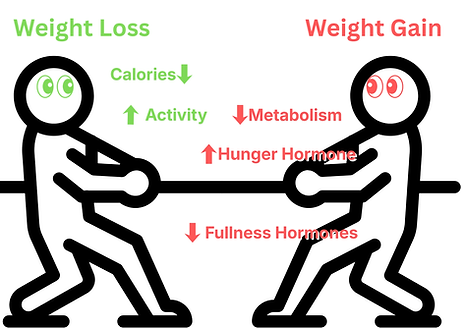
The article explains that the body powerfully resists long-term weight loss. After losing weight, appetite-increasing hormones rise, satiety hormones fall, and metabolism slows more than expected—creating strong biological pressure to regain. These changes show that obesity is a chronic medical condition, not a behavioural failure.
The authors outline how the brain, gut hormones, and fat-derived signals work together to push the body back toward its previous weight. They note that most people regain weight after dieting because these physiological adaptations persist long after the weight is lost. The paper concludes that long-term, structured support—often including medical therapies—is essential for sustainable weight management.

Association of the Magnitude of Weight Loss and Physical Fitness Change on Long-term CVD outcomes: The Look AHEAD Study
Gregg, E.W., Jakicic, J.M., Blackburn, G., Bloomquist, P., Bray, G., Chobanian, L., Corsino, L., Dutton, G., Egan, C., Evans, M. et al. 2016. Association of the magnitude of weight loss and changes in physical fitness with long-term cardiovascular disease outcomes in overweight or obese people with type 2 diabetes: a post-hoc analysis of the Look AHEAD randomised clinical trial. The Lancet Diabetes & Endocrinology, 4(11), pp.913–921.
The article shows that losing at least 10% of body weight in the first year is strongly linked to lower long-term cardiovascular risk in people with type 2 diabetes. Using data from the Look AHEAD trial, the authors found that greater weight loss—and to a lesser degree, improved fitness—reduced rates of heart attack, stroke, and related events over more than a decade.
The findings highlight that meaningful, early weight loss offers powerful health protection and reinforce the importance of structured, sustained support to help patients achieve and maintain these goals.
Nutritional priorities to support GLP-1 therapy for obesity: A joint advisory from the American College of Lifestyle Medicine, the American Society for Nutrition, the Obesity Medicine Association, and the Obesity Society
Mozaffarian, D., 2025. Nutritional priorities to support GLP-1 therapy for obesity. [Journal Name], [volume(issue)], pp.[page range]. doi:10.1016/S2667-3681(25)00025-7
The article explains how nutrition plays a critical role in supporting people using GLP-1–based therapies for obesity. Mozaffarian outlines that while these medications can substantially reduce appetite and improve metabolic health, long-term success still depends on what patients eat.
The article emphasises dietary patterns rich in whole foods, adequate protein, healthy fats, and fibre to preserve muscle mass, stabilise blood sugar, and maintain metabolic rate during weight loss.
Importantly, the authors conclude that GLP-1 medications and nutrition are not competing strategies but complementary ones. Thoughtful dietary support enhances the benefits of GLP-1 therapy, helps patients avoid nutrient gaps, and increases the likelihood that weight loss and metabolic improvements are sustained over time.
